


 Meetups
 Videos
 Podcasts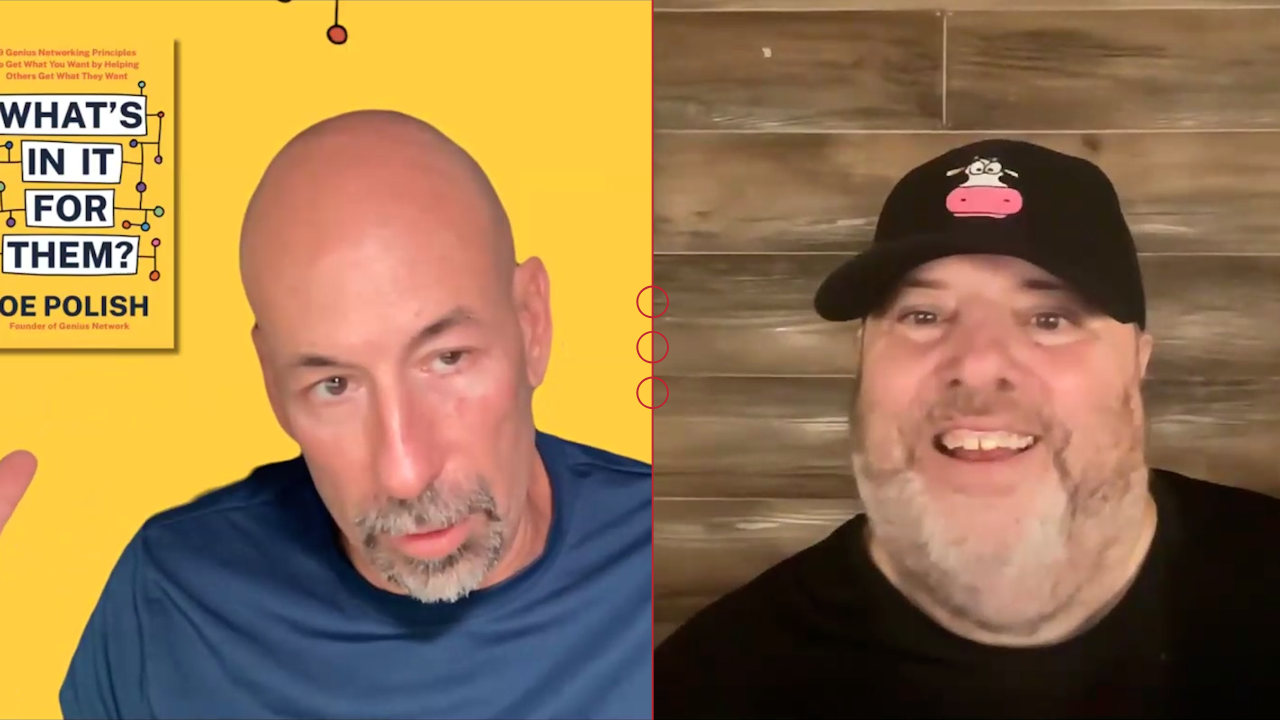
Share


Subscribe


Episode #480
The Results Economy: Getting Out of the Employee Mindset with Joe Polish and Dean Jackson
Joe Polish and Dean Jackson host a I Love Marketing Live, answering two questions the audience submitted on marketing wins and roadblocks: how a newer Entrepreneur cuts through the noise, and how a local service business turns website clicks into real trust.
The conversation runs from Dean’s blunt case for why crack sells itself to Joe’s confession about his own monkey mind, and lands on a single reframe: the signature result you’d deliver if you only got paid for the outcome, and the one list of relationships that actually cuts through the noise.
Here’s what you’re about to discover in this conversation:
- The blunt Chris Rock line Dean uses to explain why nobody sells crack, crack sells itself, and what it means for the way you position your own product.
- The one question Dean says defines a real business: what would you do if you only got paid when your client actually got the result?
- How Dean was sitting three feet from the exact person who could solve his website integration problem for weeks, separated only by a pane of Starbucks glass.
- The “What’s In It for Them” alignment model Dean compares to magnets, and why it instantly cements trust instead of repelling it.
- Building a list of the 10 to 20 highest leverage relationships in your business, and why that list matters more than any tactic.
If you’d like to join world-renowned Entrepreneurs at the next Genius Network Event or want to learn more about Genius Network, go to www.GeniusNetwork.com.
Dean’s Signature Result Question
- Dean says the single most important question any business owner can ask is what result they would create if they only got paid when the Client actually got that result.
- He connects this directly to the transition point where new Entrepreneurs get stuck trying to pick a direction or an offer.
Why Nobody Sells Crack (Crack Sells Itself)
- Dean uses Chris Rock’s famous line to make the point that a strong enough product sells itself.
- He challenges listeners to find the version of their product that people would line up for at 2 in the morning.
What’s In It For Them: The Magnetic Model
- Dean and Joe describe self-interest as a universal default. Nearly everyone is thinking about themselves, not about how to help you.
- Dean compares alignment with a Customer’s desires to a magnet flipping around: repulsion becomes an unbreakable bond once you’re facing the same direction.
- The “What’s In It For Them” question should be completely ingrained in how an Entrepreneur thinks.
Joe’s Monkey Mind and the Real Fundamentals
- Joe openly says he is a highly distracted person and would never claim to be naturally good at focus.
- He describes building architecture, scaffolding, and outside help just to function, and admits he still struggles with what people call time management.
- He reframes the real skill as managing priorities and energy rather than managing time, and lists the fundamentals he refuses to skip: real food, water, sunshine, sleep, and limiting screen time.
Employee Mindset vs. the Results Economy
- The employee mindset as getting paid for time and effort: hours logged, shifts worked, salary collected regardless of outcome.
- The Entrepreneur only gets paid for results, whether that means 100 hours a week and going broke or two hours a week and becoming a millionaire.
- The Entrepreneur does not eat if they do not catch a fish, even if the people around them still get paid.
The Shadow Self and Negative Self-Talk
- Joe describes most of his internal dialogue across his career as harsh and self-critical rather than encouraging.
- He frames this as a devil and angel dynamic on the shoulder, and connects it to how people with ADD often default into a negative internal loop.
- Part of the work, he says, is directing that same creative energy toward solving problems instead of beating yourself up.
Keith Cunningham’s Thinking Time and the 50 Minute Focus Finder
- Joe references his friend Keith Cunningham’s book The Road Less Stupid and its Thinking Time chapter, where you sit, write, and let a single question or opportunity percolate.
- He points listeners back to Dean’s 50 Minute Focus Finder, one of the very first I Love Marketing episodes, as a process for dumping and organizing everything in your brain.
- New business owners, Joe says, need to give their brain time to percolate on something new, even after years in business.
The Dan Sullivan Distinction: Time and Effort vs. Results
- Joe credits Dan Sullivan of Strategic Coach with first articulating the shift from a time and effort economy to a results economy the moment someone decides to run a business.
- Cutting through the noise, in Joe’s framing, comes down to focus on what actually matters rather than everything that could matter.
Build Your List of 10 to 20 Highest Leverage Relationships
- Make a list of the top 10 to 20 highest leverage relationships in your business or life.
- Give those specific people real time and attention through the lens of what’s in it for them, and they will help you get what you want in return.
Wayne’s Question: Turning Clicks Into Trust on a Small Budget
- Wayne asks how a local service business with a small audience and limited ad budget should structure front end offers and follow ups.
- His goal: give away genuinely useful work up front and build a repeatable path from first attention to real customer action, without it feeling like a pitch.
The Starbucks Story: Sitting Feet Away From the Answer
- Dean tells the story of sitting on a Starbucks patio in Winter Haven, Florida with his operations guy Stuart, separated by a pane of glass from Wayne, who was working at a table inside.
- Weeks later a casual conversation revealed Wayne did exactly the WordPress integration work Dean needed, and Wayne went on to do a lot of great work with them.
- Know your signature result clearly enough that a stranger understands what you do in the first exchange.

*******************************
To go deeper on the insights from I Love Marketing, access your FREE COPY of the BREAKTHROUGH REPORT, 8 Profit Activators to help you create more leads, convert more sales, and stimulate more referrals. CLICK HERE TO GET THE REPORT
*******************************
Note: The above links are affiliate links where we will receive a small commission if you then purchase the item. That is one way we can optimize this site and continue providing valuable free content.