


 Meetups
 Videos
 Podcasts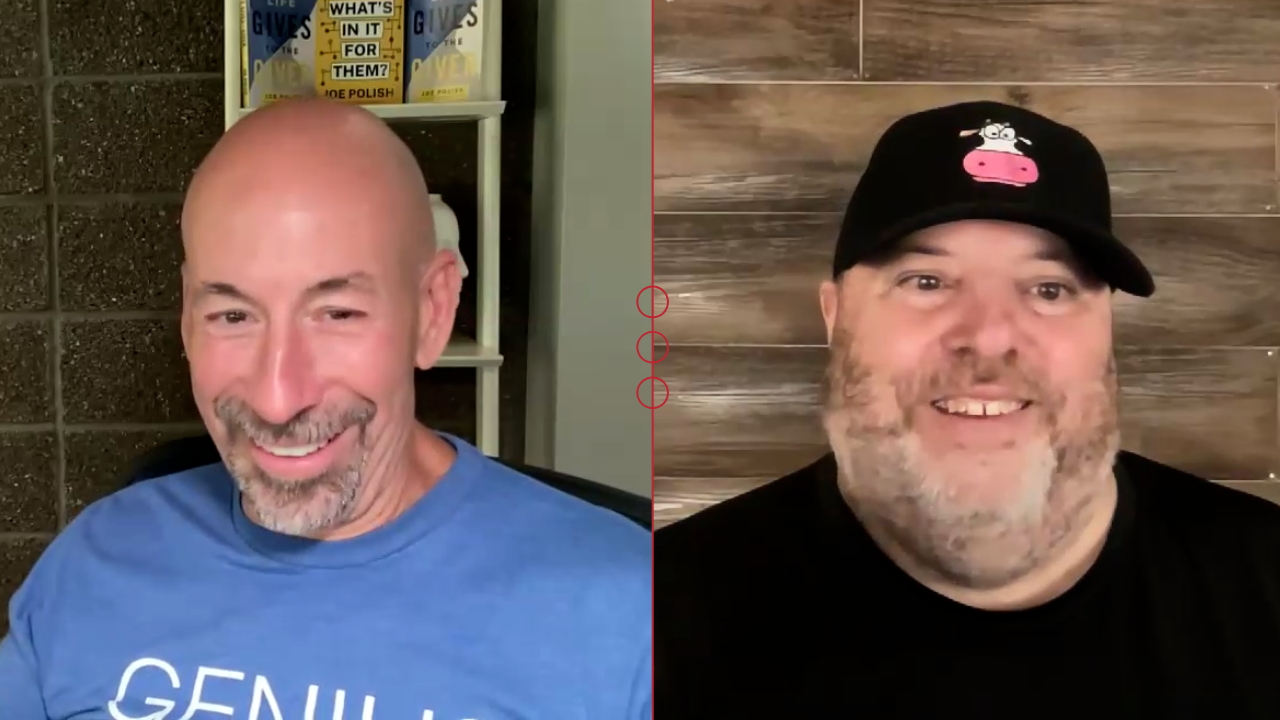
Share


Subscribe


Episode #473
From Marketing Frustration to Marketing Foundation with Joe Polish and Dean Jackson
Joe Polish and Dean Jackson go live and ask the audience the same simple question. What is your biggest marketing frustration right now, and what does it actually feel like?
The answers cluster into five patterns, and underneath all of them is the same diagnosis. People know what to do. They are stuck on focus and follow-through. This episode is the masterclass that unsticks them.
Here’s a glance at what you’ll learn from Joe and Dean in this episode:
- Why Dean says “a compelling offer is 10 times more powerful than a convincing argument,” and the jet-stream principle that makes it work every time
- The four-word filter Dean has used for 30 plus years to write every piece of marketing he touches (you can run it on anything you have already written tonight)
- Why your Customers do not know your biggest advantages, and the Schlitz beer story that turned a forgotten brand into number two in the country with a single campaign
- The 10-handwritten-notes-a-day discipline that quietly rebuilds the muscle most marketers are losing to AI
- Why Joe says “most people do not use social media, social media uses them,” and the single question that flips it
- The five clusters of marketing frustration that came up live in the audience poll, and the one thing all of them share
- The Prospect Vending Machine versus the Prospect Slot Machine: Dean’s framework that explains why your funnel feels random
- The financial advisor case study that produced a billion-dollar honey hole inside a 20 mile radius (you can run this exact play in your own market)
- Why Gary Halbert made his copywriting students hand-write his sales letters five times in a row, and what that means for working with AI without quietly making yourself dumber
- Gary Chapman’s tip on why complaints are actually love letters from your market, and how to read them
- Dean’s 50-Minute Focus Finder, the simple practice that empties the open browser tabs in your brain so you can actually finish what you start
- Why selling something nobody wants to buy taught Joe more about marketing than any course or book ever did
If you’d like to join world-renowned Entrepreneurs at the next Genius Network Event or want to learn more about Genius Network, go to www.GeniusNetwork.com.
Show Notes
The Question That Started the Episode
- Paul Colligan opens with a single live prompt. “What is your biggest marketing frustration right now and what does it actually feel like?”
- Frustrations come in clusters. Lack of clarity on the target market. Censorship. Too many ideas and too little time. Missed calls. Replacing meta ads. Poor organizational skills. LinkedIn that reads like it was written by an LLM. Overspending on stuff you cannot confirm is working.
- Dean’s reframe is the foundation of the whole episode. Marketing is people, and people pursue self-interest with absolute reliability. If you can embrace that, you have a cheat code. If you try to fight it, you are in trouble.
Compelling Offer vs. Convincing Argument
- Dean’s signature line: “A compelling offer is 10 times more powerful than a convincing argument.”
- A compelling offer moves people in the direction they are already moving. You get in the jet stream and friction drops.
- A convincing argument tries to drag people in a direction they are not naturally going. It is exhausting for you, and it feels like pressure to them.
Marketing vs. Selling
- Joe’s working distinction: selling is what you do when you are face to face or on the phone with someone. Marketing is what you do to get them to be face to face or on the phone with you, properly positioned, pre-interested, pre-motivated, pre-qualified, and pre-disposed to do business with you.
- Frustration is fear plus anger. The reason Joe used to hate marketing was that he did not understand it. He had a definition of marketing that was based on bad salespeople.
- Trust is not the same as rapport. Rapport is trust with comfort. Rapport can be built quickly. Trust takes time, and trust is rarely destroyed in one moment. It is a series of small choices that add up.
Get Benefit Now: The Four-Word Filter
- Dean got these four words from Jeffrey Lant’s 1995 book Cash Copy. He has used them as the through-line on every piece of marketing he creates for 30 plus years.
- Get. The destination, not the transportation. The outcome the prospect actually wants.
- Benefit. The result, not the mechanism. What the Customer ends up with.
- Now. The only time to act. Every piece of communication must tie back to one of these four anchors or it does not earn its space.
Select a Single Target Market (Procter and Gamble Style)
- Profit Activator one is to select a single target market. Most Entrepreneurs try to make it convenient for themselves by bundling people together. Blue collar home service workers is not a target market. Electricians are. Carpet cleaners are.
- Procter and Gamble runs 23 billion-dollar brands, each one focused on a hyper-specific market. The biggest companies on earth narrow, they do not broaden.
- Dean’s e-bike catalog Facebook ads ran four different creatives to four different segments. Single guy on a trail for men 25 to 50. A couple riding around a lake for 50 and over. A super-mom cover with a basket on the bike for women 25 to 50, which became the top performer.
Handwritten Thank-You Cards
- Joe’s challenge: write 10 handwritten notes per day, five days a week. 50 a week. Just thank-you cards. Friends. Prospects. Clients. Anyone who has done anything for you.
- Gary Halbert made copywriting students hand-write his own sales letters five times in a row. When you write the words by hand, the language penetrates your thinking and you start to feel the underlying psychology.
- Dan Sullivan-linked research has shown roughly 40 percent better retention when you write by hand instead of typing. The pen and the thumb light up memory circuits that a keyboard does not touch.
- Gary Chapman’s Five Love Languages applied to marketing: words of affirmation, physical touch, acts of service, gifts, quality time. A handwritten note hits multiple at once, and a Prospect cannot get that from an email or a Facebook post
Listen to What People Complain About
- Gary Chapman told Joe: if you want to know someone’s love language, listen to what they complain about. Complaints are usually people begging for attention.
- Marketers can read complaints the same way. The negative version of a wish is still a wish. The pain inside a complaint is the outcome the prospect actually wants.
- Most people find complaints annoying. Marketers should find them useful.
The Prospect Vending Machine vs. The Prospect Slot Machine
- Most marketers are running a slot machine. They put money in, pull the lever, and hope something comes out. They have no way of knowing which input maps to which outcome.
- A vending machine works differently. You pick what you want, you see the price, you pay it, and you get exactly that. Predictable, repeatable, designed.
- The goal is to engineer your marketing so it works like a vending machine. Specific input. Specific output. Known cost per ideal Prospect.
The Billion-Dollar Honey Hole (Financial Advisor Case Study)
- Dean worked with a financial advisor whose dream client was someone transitioning into retirement, turning assets into income.
- They defined the ideal person. 62 to 67 years old, married homeowners with two to three million in investable assets, in a one million dollar plus home, conservative voters.
- Inside a 20 mile radius of the advisor’s office, they found 4,300 of them. Dean reframed it: 1,000 of those people with a million dollars each represents a billion dollars of investable assets.
- The tactic: start with 100. Whatever you would pay to get the ideal Client, deploy that across the first 100, and let them teach you what works before you scale to the rest.
The Five Clusters of Marketing Frustration
- Parth (Joe’s AI Team Member) parsed every audience response in real time into five themes. Clarity (who is the audience and what is the message). Overwhelm and paralysis (too many ideas, too many shiny objects). Visibility and leads (getting seen without a Team, replacing meta, more discovery calls). Consistency and systems (outreach cadence, tracking, organization). Trust and connection (community, people seeing it for themselves).
- The audience then voted live on which one mattered most. Visibility and leads won by a landslide, with trust and connection close behind.
- The diagnosis underneath all five: people already know what to do. They are stuck on focus and follow-through.
AI, Cognitive Offloading, and the 50-Minute Focus Finder
- Joe is training himself to spend three hours a day off-screen. Handwriting. Reading paper books. Time without the device. He locks his phone in a lockbox from 10pm until noon and uses a Remarkable tablet during the analog hours.
- AI is a productivity superpower and a memory accelerator at the same time. The risk is camouflage laziness. If you let AI think for you, you get the words but you lose the understanding.
- Dean’s 50-Minute Focus Finder is the antidote for Entrepreneurs with too many open tabs in their brain. Get into an infinite white room, lay every idea out on a yellow pad, exhaust the working memory, then evaluate by consequence and timeframe. Most urgent items involve other people who are waiting on you.
- Daily maximizer (Tetris) versus pre-arranged song (Guitar Hero). Joe runs Tetris, Dean runs Guitar Hero. Both work. The point is to pick the song before the day picks one for you.
The Schlitz Beer Lesson
- Claude Hopkins, the father of modern advertising, was hired to advertise Schlitz beer when it had slipped to roughly number eight in the country.
- He toured the brewery and took notes on the dark bottles that prevented mold, the four-stage bottle cleaning, the 100 year old mother yeast cell, and the 4,000 foot artesian well they dug for the cleanest water.
- When he asked the executives why none of this was in their ads, they said: every beer company does this. He replied: but the consumer does not know that. He ran the campaign on those exact details, and Schlitz climbed to number two.
- The lesson for every business owner: you have a curse of knowledge about your own work. Things that are obvious to you are invisible to your market. Tell them.
Ask Joe Polish, Agentic AI, and the Curse of Knowledge
- Joe has loaded AskJoePolish.com with more than 1,000 of his videos, his books, and his articles. It is free, and it is more focused than Joe is.
- Robin Farmanfarmaian, points out that even in rooms full of CEOs, fewer than a couple of people in the room know what agentic AI actually is. That gap is the opportunity.
- Same Schlitz beer principle, modern setting. The market does not know what you know. Your job is to tell them what is in it for them.
What’s In It For Them (The Closing Principle)
- Joe’s frame: keep your give equal to or greater than your want. If you want money, referrals, attention, time, or effort from someone, your contribution into the relationship has to match or exceed it.
- Commerce, collaboration, and friendship are all the same equation. The friends who really like you are the ones to whom you genuinely give first.
- The 80/20 cuts both ways. The best move for many overwhelmed marketers is to fire the half-hard, annoying, lame, and frustrating clients and pour their attention into the easy, lucrative, and fun ones.

*******************************
To go deeper on the insights from I Love Marketing, access your FREE COPY of the BREAKTHROUGH REPORT, 8 Profit Activators to help you create more leads, convert more sales, and stimulate more referrals. CLICK HERE TO GET THE REPORT
*******************************
Note: The above links are affiliate links where we will receive a small commission if you then purchase the item. That is one way we can optimize this site and continue providing valuable free content.